
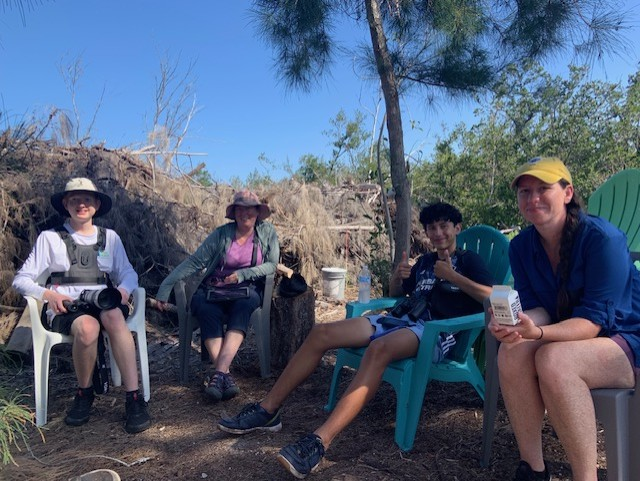
Hi all!
Here’s the report on our birding trip from last Sunday. Sorry for the delay, it’s been a busy week.
Attendees: John R, John H, Tiffany, Roland, Danielle, Nel, Tom, Michael, Edwin, Adrian, Sophia, and Tony. A nice mix of regulars and some new people. Thank you all for your help!
This was our first trip using an iPad for data collection rather than the paper forms. We were very lucky to receive a grant by Sarasota Audubon to purchase equipment to make data collection easier, including an iPad with a waterproof case.
We went on our usual path around the island, and gathered some more compelling data on the effectiveness of the restoration project. We visited our 6 point count locations (3 restored and 3 unrestored) and collected data for 10 minutes at each location. As we’ve been noticing the last few months, the restored areas had a much more diverse bird population than the unrestored areas, continuing the trend.
Some of the highlights from this trip include:
An American Redstart was seen briefly in the mangroves at Restored #1. Another sign that Jim Neville is beneficial for migratory birds.
A horde of digger wasps were flocking around Unrestored #2. I’ve attached a picture of one taken by Tom Litteral. He thinks that the group were all males waiting for the females to emerge from underground.
A mockingbird was seen exhibiting very territorial behavior at Restored #3, and repeatedly visiting a hollow tree. We think it might have been nest-building.
A Chuck-wills-widow was spotted again at Restored #3, but it was only heard this time. If you weren’t aware, the widow has been seen on the island before (picture attached) and its eggs have been seen by John Ryan before. (If anyone plans to visit the island soon, please watch your step! These birds don’t tend to build nests, they just lay their eggs on the ground).
Tom arrived to the island a little earlier and stayed a bit later than the rest of us. Here’s one of his observations:
“I did observe (2) young of the year, Carolina wrens in the area of the waterhole and the chairs set up in the main clearing. I would feel confident they are resident off-spring that are using the reclaimed area on JNMP and shows successful breeding of birds in that area. They were especially using the piles of brush (aka: rabbitat piles) as places of forage and shelter.”
Overall, all of these breeding behaviors from different species (especially in the restored areas) are a very good sign that the restoration project is successful! If this trend continues, we’ll be able to decisively say that the restoration is a success. Fingers crossed!
Here is Tom’s eBird checklist, which includes some birds he saw just before we arrived and just after we left Jim Neville: https://ebird.org/checklist/S230108244
Here’s the checklist that Roland took from when we were all together: https://ebird.org/checklist/S230108508
I didn’t take any bird photos this time but I’m sure some of the others submitted some to SBW so keep your eyes open for the FB post. The digger wasp and spinny spider photos were taken by Tom.
Thanks to everyone who’s contributed to the project. Your help is crucial to its success.
Best,
Sophia H.