
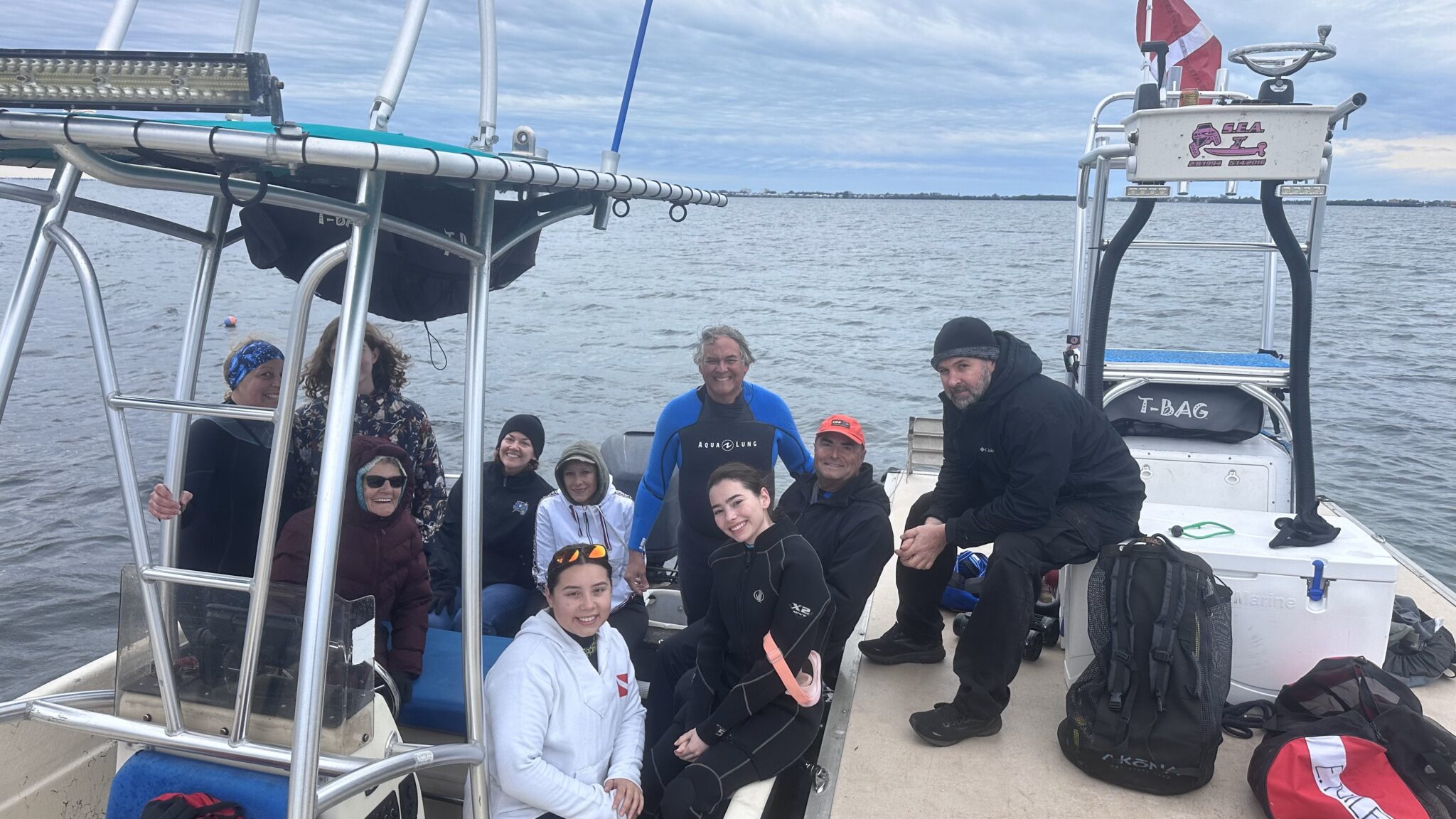
Happy New Year and we hope you all had a Clamtastic Holidays.
On Saturday January 13th a group of volunteers braved the cold 60 degree water to check on our clams at the Sarasota Bay Watch Aquaculture Lease. Two boats, courtesy of Capt. Thomas Jackson, transported 8 volunteers from Ken Thompson park to the lease. Jackets were definitely required with air temps in the low 60’s and winds blowing 10-15 knots.
After arriving at the site at 9:30 am the first order of business was to randomly select two bags of clams from the over 120 bags already at the site. Each bag at the site has approximately 650 clams capable of filtering up to 4.5 gallons per day.
To retrieve the bags divers entered the water and selected the bags at random. After the divers remove the stakes that hold the bags in place, the bags can be brought to the surface. The bags are brought back to the boat and handed off to the topside volunteers.

The topside volunteers then open the bag and assess how many clams have perished, how many clams have survived, and how many live clams are over 0.5 inches.
| Perished | Live | Size > 0.5″ | Survival Rate | |
| Clam Bag 1 | 296 | 416 | 24 | 60% |
| Clam Bag 2 | 195 | 386 | 14 | 67% |
| Total | 802 | 38 |
After the count was complete live clams were placed in the 4 new bags with a density of 200 clams per bag. Except for you one of the bags, which received 240 because it included 38 clams >0.5 inches. These 4 bags were tagged and labeled at the opening of the bag indicating the number of clams, size (> or < than 0.5 inches) and the date.

While the topsiders worked diligently to crunch the numbers, our team in the water had two separate missions to complete.
First task was to swim over the bags and look for predators, these include whelks, banded tulips, conchs, and pear whelk. Divers collect any predators they can find and place them in catch bags to be moved far away from the clam lease, increasing the survival rate of the clams.
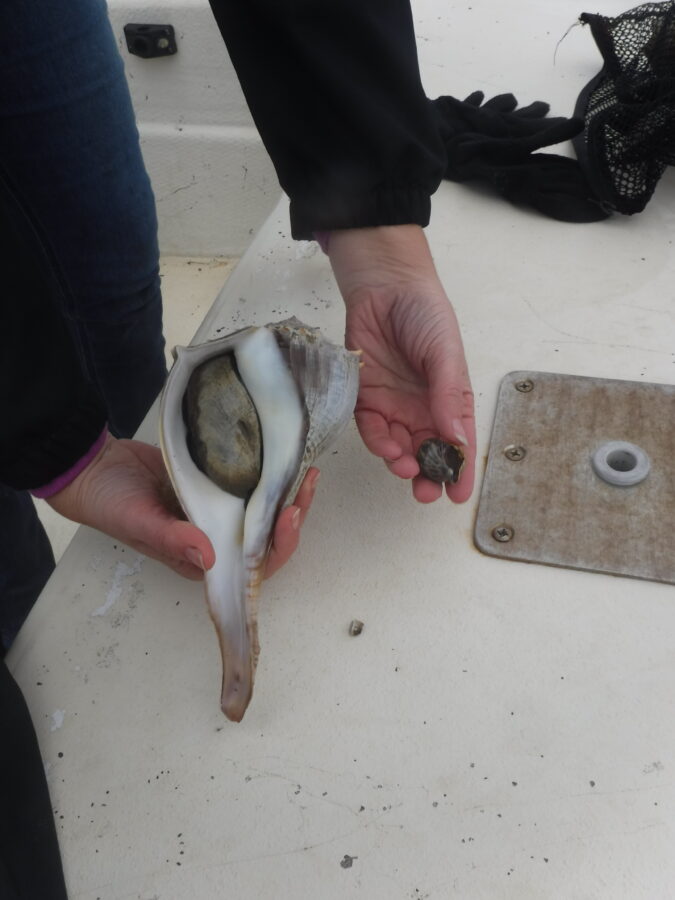
Second, was to use a large weighted broom to sweep away the drift macroalgae (Gracilaria sp.) that collects on top of the bags. This algae when it decomposes suffocates the clams. Without access to oxygen the clams perish.
Overall, it was an extremely successful day despite the conditions. We are incredibly appreciative of our volunteers who joined us on our mission of cleaning our waters through bivalve filtration. It also would not be possible without the help of our generous donors who support our cause that a healthy bay is everyone’s business.
Volunteers:
Capt. Thomas Jackson
Divers: Ernesto, Eli Niles, Martina Belanch, and snorkel Pamela Graham.
Top clam counters: Sophia Haakman (SBWY), Angelee Gens, JP Thonney, Anita Stagle and Betty.